Integration questions, answered
Do you have a marketplace of pre-built connectors?
No, and there is no catalogue of vendor integrations being built quietly in the background either. The way you integrate with Capstan today is to build against outbound signed webhooks, which are part of the core on every plan. A connector marketplace is a deferred idea rather than a dated commitment, so it is not on this page as a promise; if it ships, it will be listed here with what it actually connects to, and not before.
Are webhooks a paid add-on?
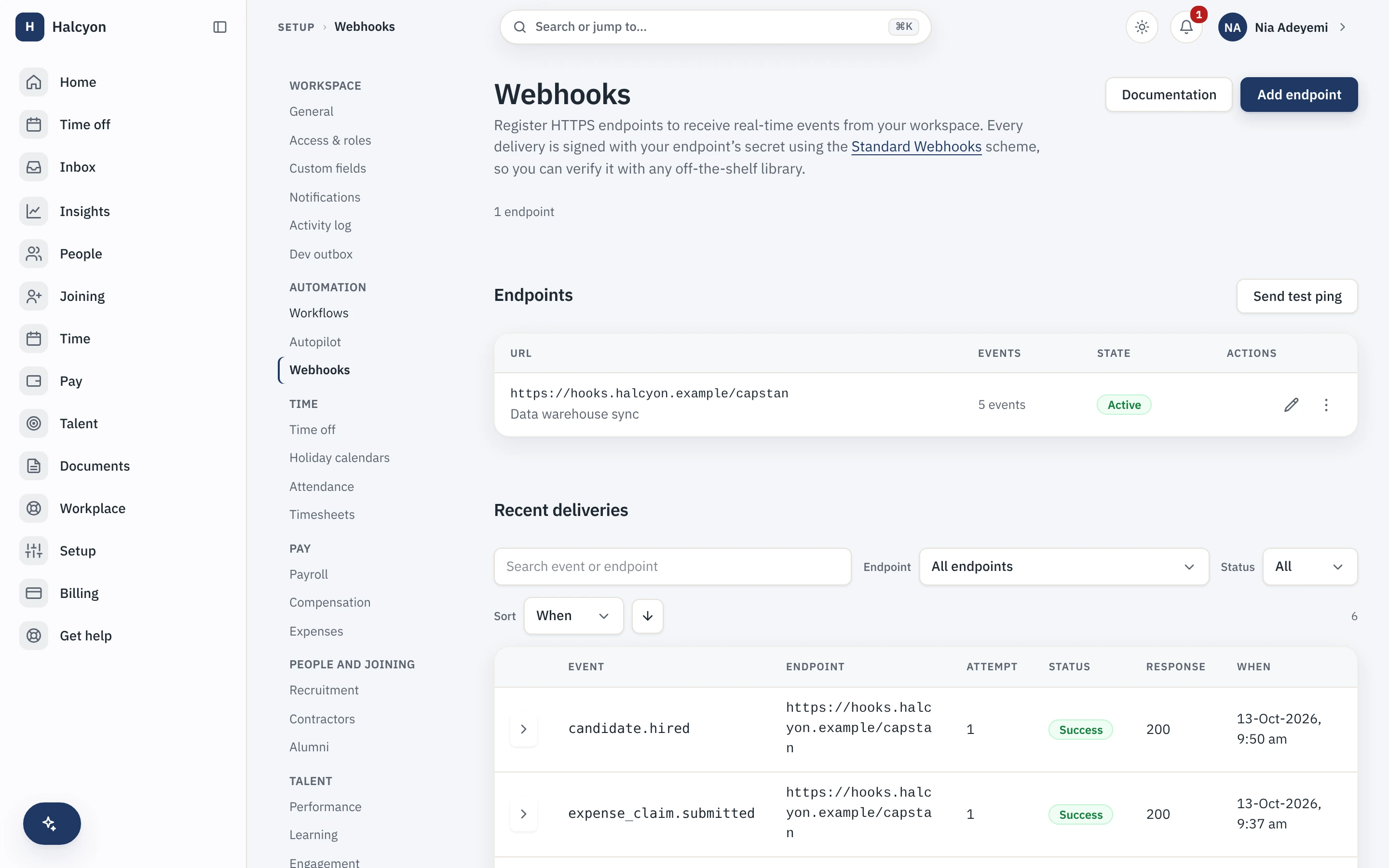
No. Outbound webhooks are a core developer feature on every plan, including the free one. They are not behind a plan gate, and a paid plan is not a precondition for using them: you can be notified of everything before you pay for anything. Endpoint registration, the signing secret, the per-attempt delivery log, manual redelivery and the in-product integration guide are all part of that same core surface.
How do I trust a webhook actually came from Capstan?
Every delivery is signed with the Standard Webhooks HMAC-SHA256 scheme. Each request carries three headers: a webhook-id, a webhook-timestamp and a webhook-signature over the exact bytes delivered, with a timestamp tolerance so a captured request cannot be replayed at you later. Verify it with any off-the-shelf Standard Webhooks library, which means you never have to trust the network or an allow-list of source addresses. The same signing scheme is what Capstan itself uses to verify inbound calls from its payment provider, so it is not a second-class path built only for customers.
Which events can I subscribe to?
A closed catalogue, grouped by module, in which every entry fires from a real place in the code. It covers contractor engagements activated and ended; recruitment events, meaning an application changing stage or being rejected, an offer extended, accepted, declined or withdrawn, and a candidate converted into an employee; expense claims submitted and reimbursed; assets issued and returned; helpdesk tickets created, resolved and closed; a review cycle completed; and a test ping you can fire on demand. Two absences are worth knowing before you design against it. Leave and expense approvals emit no event, because those transitions run through the generic workflow engine and have no clean seam to fire from. And there are no billing or invoice events at all. The catalogue inside the product is the live list, and it is closed on purpose: there are no dead event types you can subscribe to and never hear from.
Can I call the API from my own scripts?
Not yet, and the distinction matters more than a yes or no. Capstan runs on its own HTTP API, and that API is documented: the OpenAPI description is generated from the code itself and regenerated on every build, with the build failing on any difference, so the reference cannot drift away from the routes. What does not exist is the part you would need in order to call it from outside the product: API keys or personal access tokens, and a developer page to manage them. Every call today is authenticated with a signed-in browser session, which is right for the application and wrong for a script. Until keys ship, webhooks are the real integration surface and they are core and ungated. When keys ship we will say so here, and say which plan they land on.
Can I push data into Capstan from another system?
Not over the network, and not by webhook. Webhooks run one way only: Capstan posts to your endpoints, and there is no inbound receiver for you to post events at. Without API keys there is also no authenticated way for one of your scripts to write. What does exist is file-shaped and deliberate: a spreadsheet import for people, a CSV import for a holiday calendar, a CSV import for the asset register, a per-person bulk document upload, and the payroll partner export and its matching import of the partner’s computed results. Those are the write paths today, and the switching page describes each one and its limits.
What are the rate limits?
There is no published per-customer API rate limit, because there is no public API surface to put one on yet. What is limited today is a specific set of expensive or abuse-prone operations inside the product: signup, which has its own per-address and per-email limiter, verification resend, token confirmation, starting a full tenant export, and running a report. Those limits are configuration rather than a published contract, and interactive sign-in is limited by the identity provider that issues the session rather than by us. Outbound webhooks have no throttle in the other direction: Capstan posts an event when the event happens, so your endpoint should accept bursts and return quickly rather than doing work on the request. When a public API with keys ships, its limits publish alongside it.
How is any of this versioned?
The API is versioned in the path: every route lives under a version prefix, and the generated OpenAPI description is regenerated on every build with the build failing on any difference, so what is documented is what is deployed. Clause 8.3 of the terms of service carries the standing policy that goes with that, meaning a breaking change ships only as a new version, a deprecation carries at least six months of notice, and a version is supported for at least twelve months after its successor. Clause 8.3.1 then states the limit of what that policy currently governs, which is that there is no public API surface today, so there is nothing yet under contract to deprecate. The policy binds us from the day keys ship. The webhook event catalogue is a closed vocabulary held in the database, so adding an event type is a migration plus an emit call at a real seam rather than a silent change, and an event type cannot exist without somewhere that fires it.
What happens if my endpoint is down for a long time?
Each delivery is retried with backoff up to five attempts, and every attempt is recorded against the endpoint with the request that was sent and the response that came back, so a failure is visible rather than inferred. Each attempt also records whether it will be retried, so the log distinguishes retrying from terminally failed, and a delivery that exhausts its attempts dead-letters rather than looping. If an endpoint fails ten times in a row, Capstan disables it and sends your workspace admins a security-category notification, so a dead endpoint tells you rather than silently swallowing events. Re-enabling the endpoint clears the failure streak. Anything in the delivery log can be redelivered by hand, and a redelivery records the next attempt against the same event rather than inventing a duplicate one. The boundary worth knowing: while an endpoint is disabled, new events are not queued for it, so a long outage leaves a gap you close by reading the data through the product rather than by replaying a queue we held for you. Every delivery carries a webhook-id that is stable across retries, so your receiver can deduplicate on it.
How do webhook signing secrets work, and can I rotate one safely?
Yes, without dropping a delivery. A signing secret is per endpoint, not per workspace, and it is shown to you exactly once, when the endpoint is created or the secret is rotated. After that it is stored only as ciphertext under the same per-tenant envelope encryption as the rest of your sensitive data, so the database never holds it in plaintext and nobody here can read it back to you. Rotation is zero-downtime: the outgoing secret moves to a previous slot for twenty-four hours, and every delivery in that window is signed with both the new secret and the old one at once. The Standard Webhooks format carries a list of signatures, so a receiver part way through your rollover verifies against whichever secret it currently holds, and no delivery is lost while you deploy.
Is there a sandbox or test workspace?
No, and we are not going to imply one. There is no test workspace you can provision alongside your live one, and nothing is built towards one today. What you do have for testing an integration is narrower and real: a test ping action that delivers a signed event to your endpoint on demand, a per-attempt delivery log showing the exact signed request and your endpoint’s response, filterable by endpoint and by status, a redelivery action, and a standalone, printable integration guide inside the product covering the envelope, signature verification and retries. The sensible sequence is to verify your signature checking against a ping before you rely on a real event.
Can a webhook failure break something inside Capstan?
No, and that is a structural property rather than a promise to be careful. An event is emitted at the domain seam through the service role, and the emit call swallows its own failures, so a webhook that cannot be written never rolls back the business action that produced it. An offer is accepted, an asset is issued and a ticket is resolved whether or not the notification of it succeeds. The same separation runs the other way: a delivery is posted with a ten-second timeout by a background job on the queue, never on the request that caused the event, so a slow endpoint of yours cannot slow the product down for the person clicking the button.
Who can register an endpoint, and what ends up in a payload?
Only a workspace admin, and less than you might expect. Endpoint registration, editing, disabling, deletion, secret rotation and redelivery are admin-only, enforced by row-level security in the database and by a re-asserted admin check in the handler rather than by hiding a menu item. The target has to be an https:// URL. The identity classes with a narrow view of a workspace, external users and alumni, are denied by default, so they cannot register a destination for your events. Payloads carry ids and low-cardinality fields rather than bulk personal data, which means an endpoint is a signal to go and read the record, not a second copy of your directory sitting on someone else’s server.
Which payroll partners do you support?
Any partner that can read a file. Capstan compiles the payroll inputs it already holds, attendance, leave, overtime, compensation, expenses and prorations, into a documented, partner-neutral export in CSV and JSON on a versioned schema, and files the partner’s computed results back as payslips and records against each person. There is no partner allow-list and no certified-partner programme, because the export is a format rather than an integration with a named vendor. Capstan computes no statutory payroll itself: it holds no rate, slab, bracket or formula anywhere, and that absence is permanent and structural rather than a gap waiting to be filled.
Do contractor tax rules update without waiting for a software release?
Yes, because you configure them as data rather than us shipping them as code. Contractor withholding rules, tax lines and document requirements are a country pack your workspace owns per jurisdiction: a draft pack appears the moment you add a contractor in a country, you fill in that jurisdiction’s values, and you activate it when they are ready. A rate change after that is an edit you make, not a deployment you wait for. At invoice time the active pack suggests editable tax lines matched to the engagement’s jurisdiction, and every generated line records the pack it came from. The suggestion is a default your accountant edits before submitting, never a calculation you cannot touch, and a draft or unconfigured jurisdiction suggests nothing rather than guessing. India ships with starter values to build on; every other country you fill in yourself. This is contractor invoicing, not payroll, which Capstan never computes.
Does attendance work when there is no signal?
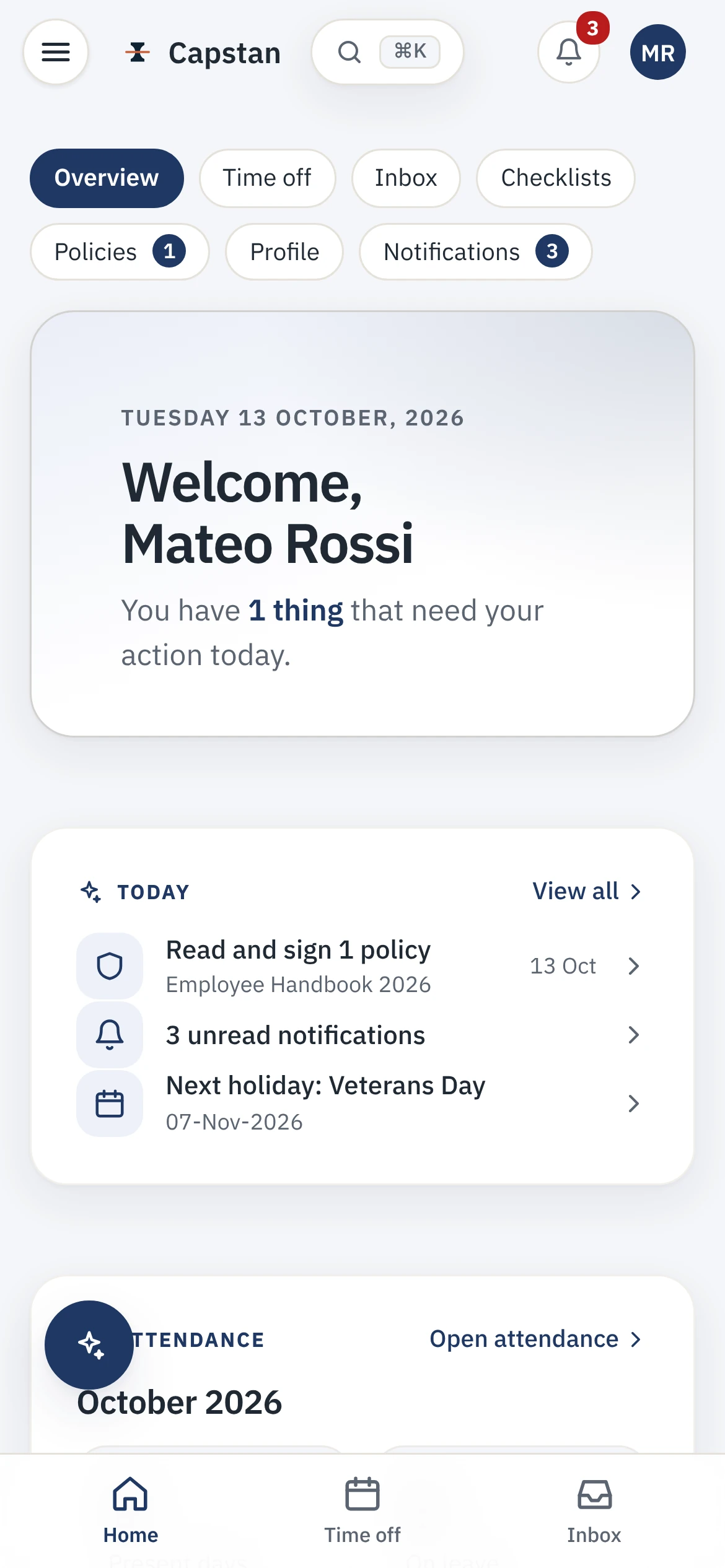
Punching does, and almost nothing else does, which is the point. Capstan installs to a phone home screen as a progressive web app, and offline it holds exactly two things: your last-known punch state for today, and the punches you have made that have not reached the server yet. A punch made offline is queued on the device with a client-generated idempotency key, so a replay can never become a double punch, and with its in or out direction inferred locally from your last-known state, shown to you and confirmed before it is queued. The queue replays in time order when the app reopens, when the network returns, or when a session comes back after signing in, and it refuses to replay without a valid session rather than dropping anything. Balances, documents and approvals are deliberately not available offline, because a stale approval list or a stale balance is misleading in a way that matters, and staleness of that kind is worse than absence.