
Included on every plan
Training assignments and completion tracking without an LMS project
The Learning module builds courses from your own documents, links and text, assigns them to individuals or by org scope with due dates, adds an optional quiz with a pass threshold, and derives completion from what people actually finished rather than from a counter. It is included on every plan at no extra charge, and it meters active learners internally.
- Counted on
- per active learner, monthly. Counted on its own unit, and only on the units active that month, so everyone else is free.
- Published limits
- 5, taken from the module specification and printed in full below.
- Documented seams
- None. It builds on the core and needs no other module switched on.
- In the catalogue
- How people are doing
- How you get it
- It is already included, on every plan and the free one too, at no extra charge. There is nothing to buy and nothing to switch on module by module. What every plan includes, and what is true of every module.
Learning (LMS) in the product
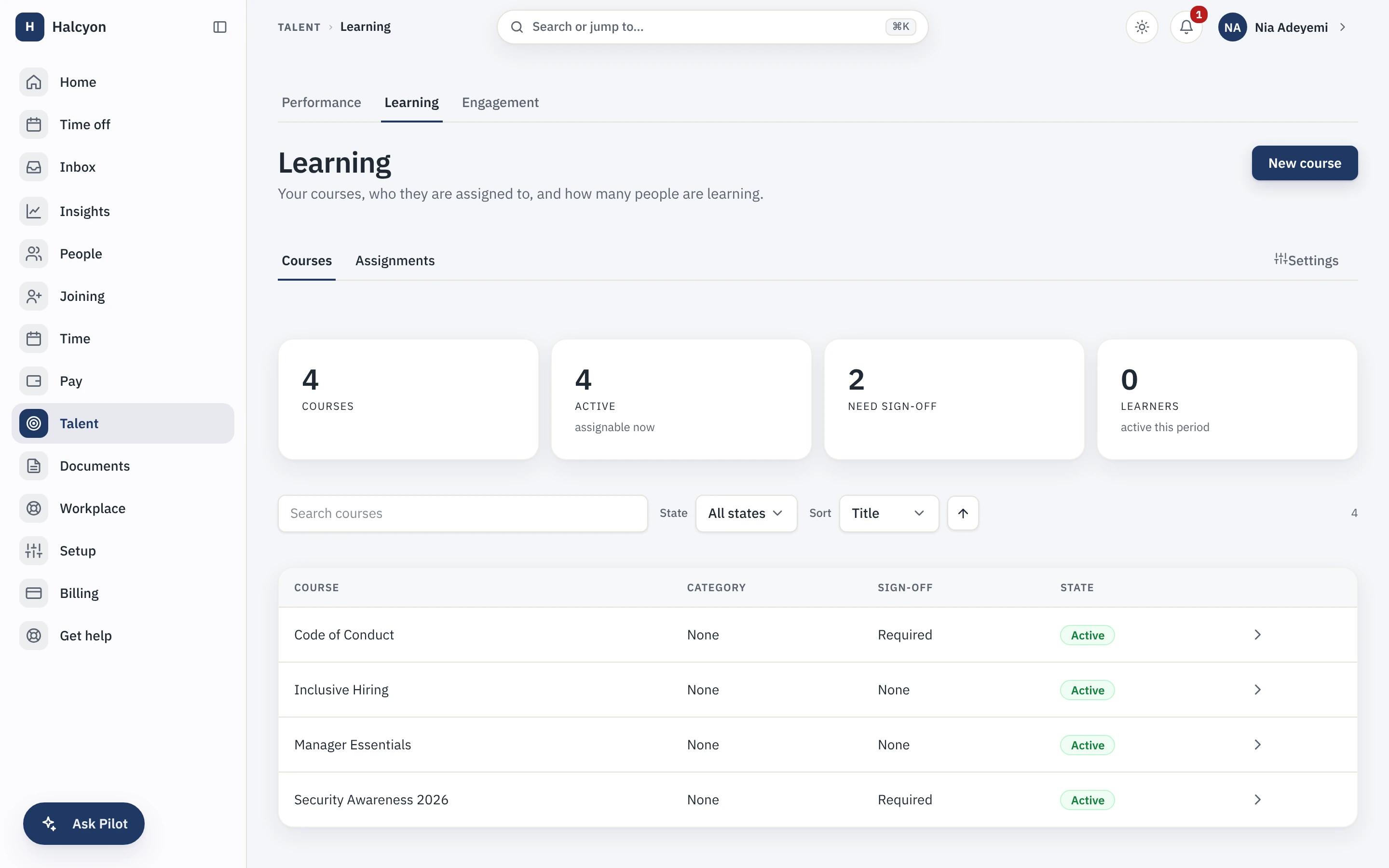
A real capture from the demo workspace, a global company with a team across the US, the UK and India. Not a mockup.
What Learning (LMS) does not do
Every module here publishes its non-goals, from its own specification. Boundaries you learn before buying are features; boundaries you learn after are refunds.
5 published for Learning (LMS)
-
It is not a content marketplace.
You bring your own material or link out to it.
-
It is not SCORM or xAPI, and it hosts and streams no video.
Courses link to your own hosting.
-
It does not schedule instructor-led or classroom training, and it keeps no waitlists.
-
It does not chain learning paths or curricula.
A course can name a single prerequisite course, and nothing deeper.
-
It issues no designed certificates.
The evidence is the completion record, with a letter through the existing letters machinery if you need paper.
How it runs in practice
A policy course is assigned across an org scope with a due date and a required acknowledgment, the due-soon reminder chases the stragglers, and the compliance report shows assigned against completed against overdue without anyone maintaining a spreadsheet. Only the people holding an assignment that month count as active learners.
Where Learning (LMS) meets your other modules
Learning (LMS) has no documented seam with another module. It builds on the core, like every module in the catalogue, and needs no other module switched on. See the other 13.
Learning (LMS) questions
Who is the Learning module for?
Companies with training they can prove was completed: a policy everyone has to read, an induction course, a compliance module a regulator or a customer asks about. The buyer is HR or whoever owns compliance. It suits a company that already has the material, in documents, links or written text, and needs assignment, chasing and evidence around it. It is not for a company shopping for course content, because none is included, and it is not a replacement for a specialist learning platform if you need interactive courseware.
Does Learning add to my bill?
No. It is included in your plan at no extra charge and raises no invoice line, whatever you assign. The module keeps an internal meter of active learners, distinct people holding at least one assignment to a live course in a given month, but that meter is never charged: the only charge on your account is the plan per-seat rate on your employees past the first twenty.
What do I need in place before I can turn Learning on, and how much setup is it?
Nothing to turn on: every module is included on every plan, the free one included, so a workspace already has this from the day it is created, on Free as much as on Growth. After that the setup is your content rather than our configuration: you build courses from your own documents, links and written text, then assign them to individuals or by org scope with a due date. A quiz with a pass threshold is optional, as is a required acknowledgment at the end. Assignment by org scope means the structure in the core needs to be right, or you will be assigning person by person. The honest expectation is that writing or gathering the material is the whole job, and setting it up in the module is an afternoon.
What does the Learning module explicitly not do?
It is not a content marketplace: you bring your own material or link out to it, and no library is included. It is not SCORM or xAPI, and it hosts and streams no video, so courses link to your own hosting. It does not schedule instructor-led or classroom training and keeps no waitlists. It does not chain learning paths or curricula: a course can name a single prerequisite course and nothing deeper. And it issues no designed certificates; the evidence is the completion record, with a letter through the existing letters machinery if you need paper.
How does Learning fit with the core and the other modules?
Course material lives in the core document store, the completion acknowledgment uses the core acknowledgment mechanic that the rest of the product already uses for policies and letters, due-date chasing rides the core notification ladder, and assignment by org scope reads the core org structure. Completion reports register with the core report registry, so they are scoped by the viewer’s own permissions. It needs no other module. Contractor Management is the one soft link: contractors can be assigned courses while that module is enabled. Onboarding checklists in the free core and course assignments are separate mechanisms that sit beside each other rather than one driving the other.
What happens if I turn Learning off?
Courses, assignments, quizzes and completion reporting stop being reachable, and because the module is part of your plan there is no separate charge to stop. The data is retained on a schedule and restored if you re-enable within that window, so completion records are not lost when a compliance cycle ends and you switch the module off until next year. A full workspace export includes module data whether or not the module is currently enabled, which matters here more than most: the completion record is the evidence, and evidence you cannot take with you is not evidence.
Learning (LMS) is included on every plan, the free one included.