
Included on every plan
An HR case inbox instead of a shared email account
The Helpdesk module gives employees a place to raise an HR question and gives HR a real queue: categories with default assignee rules, a five-state ticket lifecycle, threaded replies with internal-only notes, and SLA clocks derived from the ticket’s own history rather than from a stored counter. It is included on every plan at no extra charge.
- Counted on
- per employee, monthly.
- Published limits
- 5, taken from the module specification and printed in full below.
- Documented seams
- 1, to one other module . Each one is optional, and absent rather than broken when the other is off.
- In the catalogue
- Running the HR function itself
- How you get it
- It is already included, on every plan and the free one too, at no extra charge. There is nothing to buy and nothing to switch on module by module. What every plan includes, and what is true of every module.
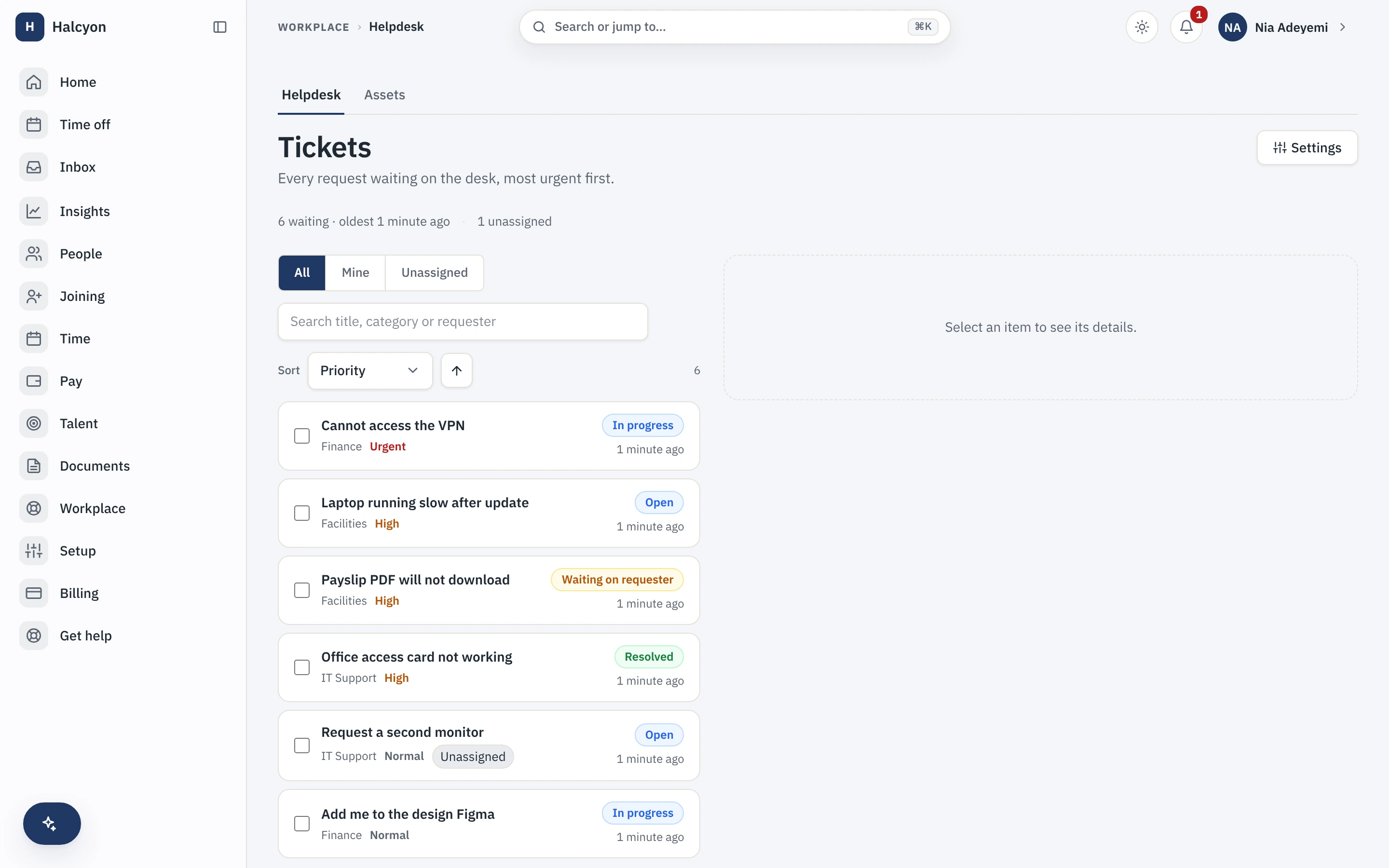
Helpdesk in the product
A real capture from the demo workspace, a global company with a team across the US, the UK and India. Not a mockup.
What Helpdesk does not do
Every module here publishes its non-goals, from its own specification. Boundaries you learn before buying are features; boundaries you learn after are refunds.
5 published for Helpdesk
-
It is not a customer-support product.
Requesters are your own people and agents are your own staff.
-
There is no email-in ticket creation.
A ticket starts in self-service, or in the contractor portal when that is enabled.
-
There is no knowledge base and no article library.
-
A ticket is not an approval.
Approvals live in the workflow engine, and a category that needs one binds that engine rather than growing a second one here.
-
No CSAT surveys, and no automation rules or macros.
How it runs in practice
Payroll questions stop living in DMs. An employee raises a case from self-service with an attachment, it routes by category to the right assignee, agents keep internal notes the requester can never see, and the resolution clock pauses while a ticket waits on the requester. A missed target is recorded as a breach event rather than quietly forgotten.
Where Helpdesk meets your other modules
Each of these is a boundary both specifications state, so it reads the same from either side. Every one is optional: with the other module off, the capability is absent rather than broken.
- Contractor Management
A ticket can start in the contractor portal as well as in self-service.
Helpdesk questions
Who is Helpdesk for?
Companies where HR questions currently arrive in direct messages and a shared inbox, and where nobody can say how long the last payroll query took to answer. The buyer is the HR lead who is tired of losing requests between three channels. It becomes worth having at the point where more than one person answers those questions, because that is when assignment and internal notes start to matter. A five-person company where the founder answers everything does not need a queue.
What do I need in place before I can turn Helpdesk on, and how much setup is it?
Nothing to turn on: every module is included on every plan, the free one included, so a workspace already has this from the day it is created, on Free as much as on Growth. Then the setup is light and mostly optional. Priorities are seeded, so a ticket can be raised immediately. What you configure is your categories and their default assignee rules, whether contractors can raise tickets, which is only offered while Contractor Management is enabled, and which notification rungs are on: assignment and replies are on by default because they are the product working rather than an optional extra. Service-level policies are the one thing that ships empty; until you create one, the service-level features are visible but dormant, and the product says so rather than hiding them.
What does Helpdesk explicitly not do?
It is not a customer-support product: requesters are your own people and agents are your own staff. There is no email-in ticket creation, so a ticket starts in self-service, or in the contractor portal when that is enabled. There is no knowledge base and no article library. A ticket is not an approval: approvals live in the core workflow engine, and a category that needs one binds that engine rather than growing a second approval system here. And there are no satisfaction surveys, no automation rules and no macros.
How does Helpdesk fit with the core and the other modules?
It uses the core rather than reimplementing it: attachments are documents in the core document store, notifications ride the core notification ladder, visibility is scoped by the core org structure, and a category that needs an approval binds the core workflow engine instead of adding a second one. It needs no other module. Contractor Management is the one soft link: contractors can raise tickets while that module is enabled, and the option is simply absent when it is not. If you use outbound webhooks, which are core on every plan, this module emits events when a ticket is created, resolved and closed.
What happens if I turn Helpdesk off?
The queue, tickets, categories, internal notes and the helpdesk reports stop being reachable, and because the module is part of your plan there is no separate charge to stop. Ticket history is not deleted: it is retained on a schedule and restored if you re-enable within that window, and a full workspace export includes module data whether or not the module is currently enabled. Attachments remain documents in the core document store under the same visibility rules as any other document. People go back to asking HR the way they did before, which is the honest description of what you lose.
Helpdesk is included on every plan, the free one included.