
Included on every plan
Performance reviews and OKRs without the ceremony
The Performance & OKR module runs review cycles on top of the core people records: your own timeline, your own questions, your own rating scale, with self-assessments, manager assessments and goals recorded beside them. It ships the machinery and sane empty states, never an opinion about how performance should be managed. It is included on every plan at no extra charge.
- Counted on
- per employee, monthly.
- Published limits
- 5, taken from the module specification and printed in full below.
- Documented seams
- 1, to one other module . Each one is optional, and absent rather than broken when the other is off.
- In the catalogue
- How people are doing
- How you get it
- It is already included, on every plan and the free one too, at no extra charge. There is nothing to buy and nothing to switch on module by module. What every plan includes, and what is true of every module.
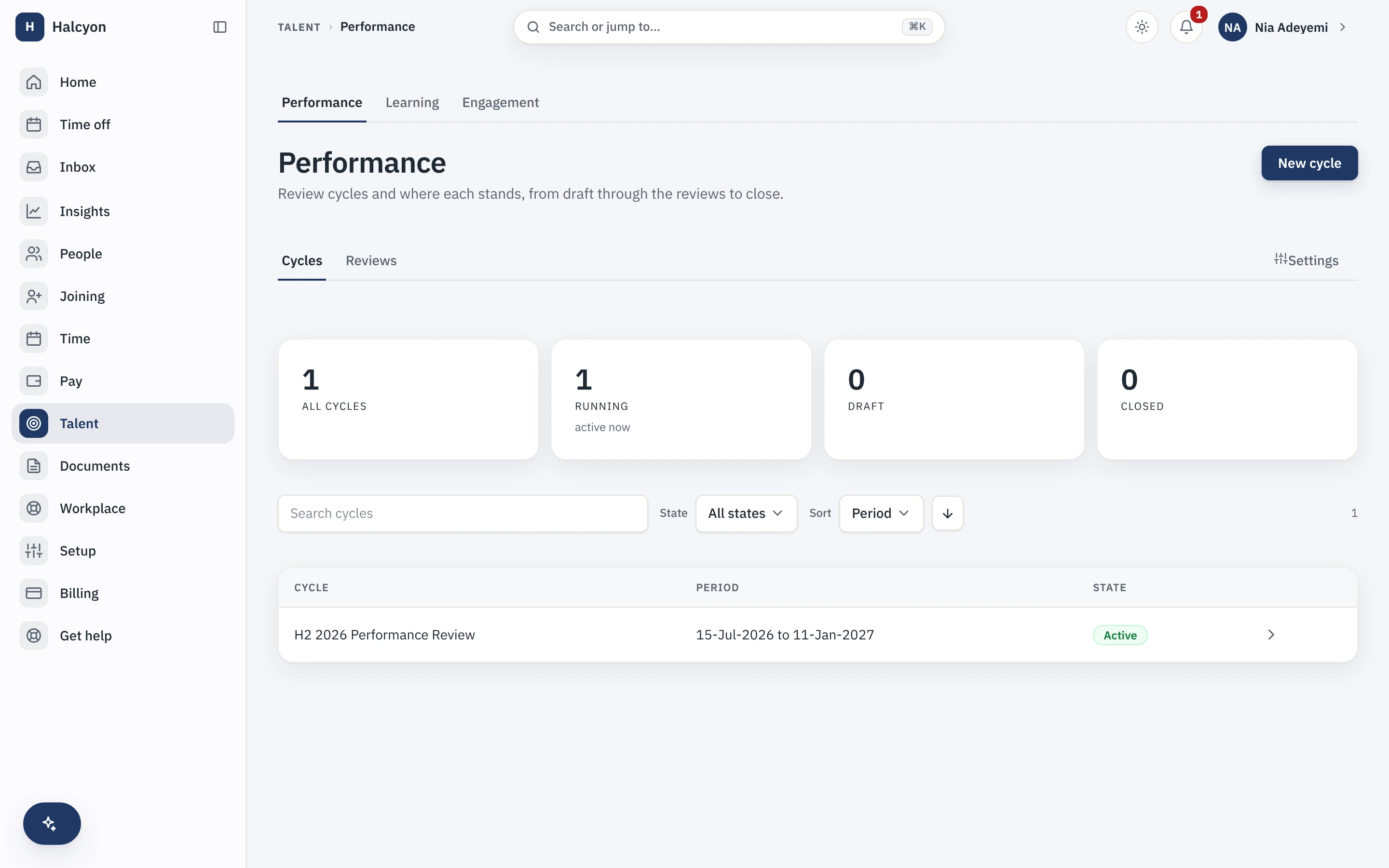
Performance & OKR in the product
A real capture from the demo workspace, a global company with a team across the US, the UK and India. Not a mockup.
What Performance & OKR does not do
Every module here publishes its non-goals, from its own specification. Boundaries you learn before buying are features; boundaries you learn after are refunds.
5 published for Performance & OKR
-
No AI writes, summarises or scores a review of a person, and no algorithm produces a rating.
A manager sets one overall rating on your own scale.
-
No calibration sessions, no forced distributions and no stack ranking.
-
No 360 or peer feedback, no praise walls and no 1:1 meeting tooling.
-
No automated compensation outcome.
A rating is readable by compensation-capability holders for their own process; nothing here writes a raise.
-
No succession planning, and no dedicated PIP machinery.
A PIP is representable as a goal set.
How it runs in practice
A 50-person company runs a light half-yearly cycle: a short self-assessment, then the manager assessment with one overall rating, finished in a week because the forms are short and the reminders do the chasing. Assessments are immutable once submitted, so a correction is a reasoned, audited reopen rather than a quiet edit, and the employee acknowledges the review when it is released. OKRs live beside the reviews, not in a separate tool.
Where Performance & OKR meets your other modules
Each of these is a boundary both specifications state, so it reads the same from either side. Every one is optional: with the other module off, the capability is absent rather than broken.
- Compensation & Equity
A rating is readable for a compensation process; nothing in either module writes a raise.
Performance & OKR questions
Who is Performance & OKR for?
Companies that have decided how they want to run reviews and need the machinery to run them, rather than companies looking for a methodology. It ships cycles, forms, scales and goal vocabularies as your own data and no opinion about how performance should be managed, which makes it a good fit for a team that already knows its cadence and a poor fit for a team hoping the software will decide. It is most useful once managers and reports are modelled in the org chart, because the module derives who reviews whom from that structure rather than asking you to maintain a second list.
What do I need in place before I can turn Performance & OKR on, and how much setup is it?
Nothing to turn on: every module is included on every plan, the free one included, so a workspace already has this from the day it is created, on Free as much as on Growth. Then your org structure needs to be accurate, because manager reach is derived from it rather than assigned separately. The configuration itself is all self-serve tenant data: your rating scale, your review form questions, the cycle and its timeline of self-assessment window, manager window and acknowledgment, who may set goals (employee, manager or both), when a self-assessment becomes visible to the manager, whether a review releases automatically on close or explicitly, and which reminder notices are on. Required vocabularies seed themselves, so an empty workspace is usable before you have configured anything. The real work is agreeing the questions and the scale, which is a conversation rather than a configuration task.
What does Performance & OKR explicitly not do?
No AI writes, summarises or scores a review of a person, and no algorithm produces a rating: a manager sets one overall rating on your own scale. There are no calibration sessions, no forced distributions and no stack ranking. There is no 360 or peer feedback, no praise wall and no meeting tooling for one-to-ones. There is no automated compensation outcome: a rating is readable by compensation-capability holders for their own process, and nothing here writes a raise. There is no succession planning and no dedicated performance-improvement-plan machinery, though a plan is representable as a goal set. OKR trees stop at a single optional parent link; there is nothing deeper.
How does Performance & OKR fit with the core and the other modules?
It sits directly on the core’s org structure and permission scoping: managers reach their own reports because the org chart says so, not because someone maintained a reviewer list. It uses the core’s acknowledgment mechanic for the employee sign-off at the end of a cycle, the core notification ladder for reminders, and the core report registry for its reporting. It requires no other module. Its relationship with Compensation & Equity is deliberately one-directional and manual: a rating can be read by someone with compensation clearance while they run a revision, and nothing here writes a pay change. If Advanced Analytics is enabled, cycle completion data can be composed into a dashboard, still under the viewer’s own permissions.
What happens if I turn Performance & OKR off?
Cycles, forms, assessments and goals stop being reachable, and because the module is part of your plan there is no separate charge to stop. The data is not deleted: it is retained on a schedule, and re-enabling within that window restores it as it was, including closed cycles and their ratings. A full workspace export includes module data whether or not the module is currently enabled, so a review history is never trapped behind an entitlement. Nothing in the free core changes, because reviews were never part of it.
Does Performance & OKR add to my bill?
No. It is included in your plan at no extra charge and adds nothing to your invoice, whatever your headcount. The only charge on your account is the plan per-seat rate on your employees past the first twenty. Participants in a given cycle are a separate matter entirely from billing: they are snapshotted from your chosen org scope when the cycle is activated, and someone joining after that is next cycle’s problem rather than being added mid-flight.
Performance & OKR is included on every plan, the free one included.